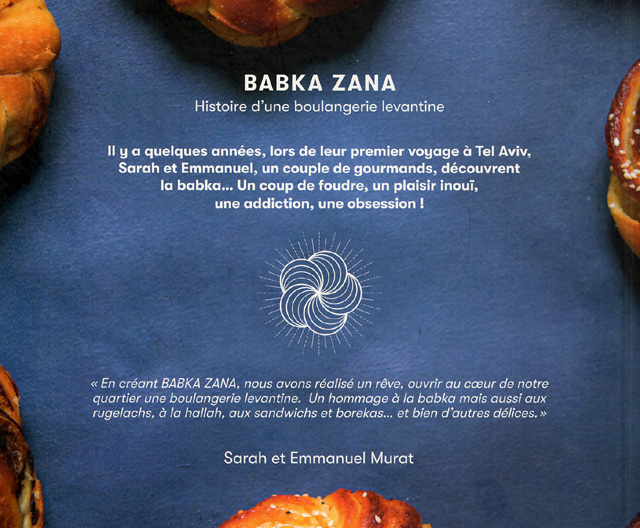
In France in May we made our annual pilgrimage to Mollat, Bordeaux ‘s great bookshop and, as usual, headed straight to the cookery section and homed in on the bread books.

This is what was available this year. Right at the moment they seem to be going in for massive volumes of the Complete Book of the Bakery variety you’d need a fork lift truck to shift.
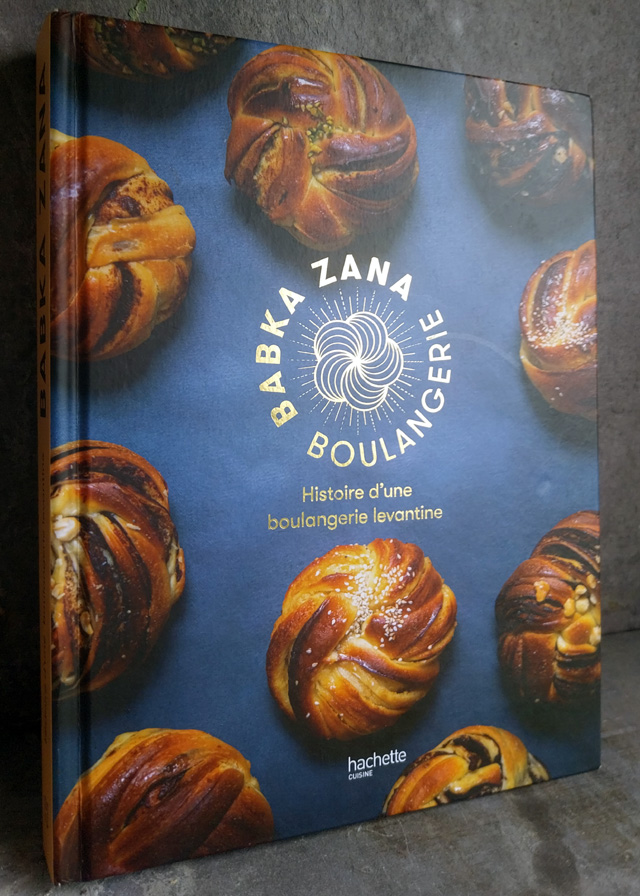
The two books that caught my eye were both Levantine, Babka Zana Boulangerie and Beirut Bakery: not in the super-heavyweight class but hefty enough to leave until we got home. (Discovered a French online book seller, Lireka, that delivers free worldwide.)
Turns out that Beirut Bakery isn’t really a bread book; rather a handsome book of Lebanese sharing food. But as it would be unthinkable to have Lebanese food without bread, it has fairly basic recipes for pita, manouche, etc. Anyway, haven’t got time to have a good look at it yet because Babka Zana is going to keep me occupied for some little while.
What I like about the book is it’s French but not stuck in the French tradition, Middle Eastern but significantly different to the books I know in the UK most of which are light on the bread content (because obviously it’s too hard a subject for home cooks). Babka Zana starts with the bread and then shows you what you can do with it. There are sections on Babkas, Brioches, Hallah, Sandwichs, Borekas, Rugelaschs, Cakes and sweet things + a final chapter on sauces, sweet fillings, pickles, pestos, etc.
I’m taking a great swerve away from home milling, wholemeals and darker flours while I poke around this book for a change. I mean I even bought T45 flour! (took Shiptons three attempts to get the order right).
I always think of babkas as being sweet and I don’t do sweet. A relief then to find that there is plenty of savoury baking in the book. Of course, all the leavening is commercial yeast and, for me, has to be converted to sourdough. But then I’m used to that.
So, to begin with, I’ve skipped the first section of sweet babkas and got amongst the Hallot (I didn’t know that the French for what is known to me as Challah is Hallah, and the plural is Hallot).
They have three Hallot in the book, La Hallah ou Pain de Shabbat, Hallah au Blé Complet and Hallah à l’Huille d’Olive. I start with the olive oil bread.

This was my first adaptation of their olive oil challah. Note the amount of sugar and the comparatively high percentage of salt. This weight of dough (960g) is for three breads.

The breads themselves came out fine but too sweet for our tastes.
Then I tried their Pain de Shabbat, again sticking closely to the recipe (except for the sourdough conversion and adjusting the flour weight up slightly).

Even more sugar in this one!

Came out really well (apart from the sweetness).
We don’t talk about the wholemeal challah except to say that, in calculating the starter, I subtracted 70g from 260g and arrived at 290g of water which produced a sort of porridge requiring the addition of a substantial amount of extra flour to produce a workable dough …

Looks good though …
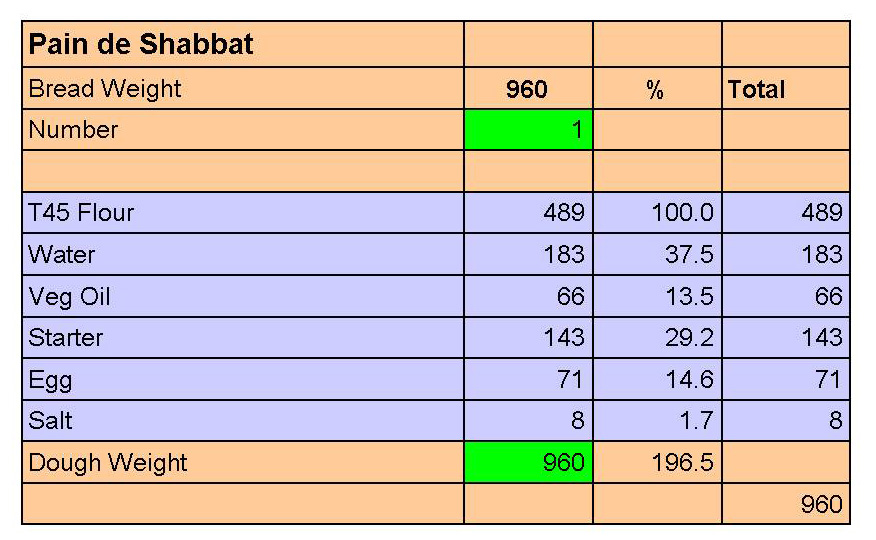
Second go with Pain de Shabbat, now with no sugar, reduced salt and flour weight adjusted.
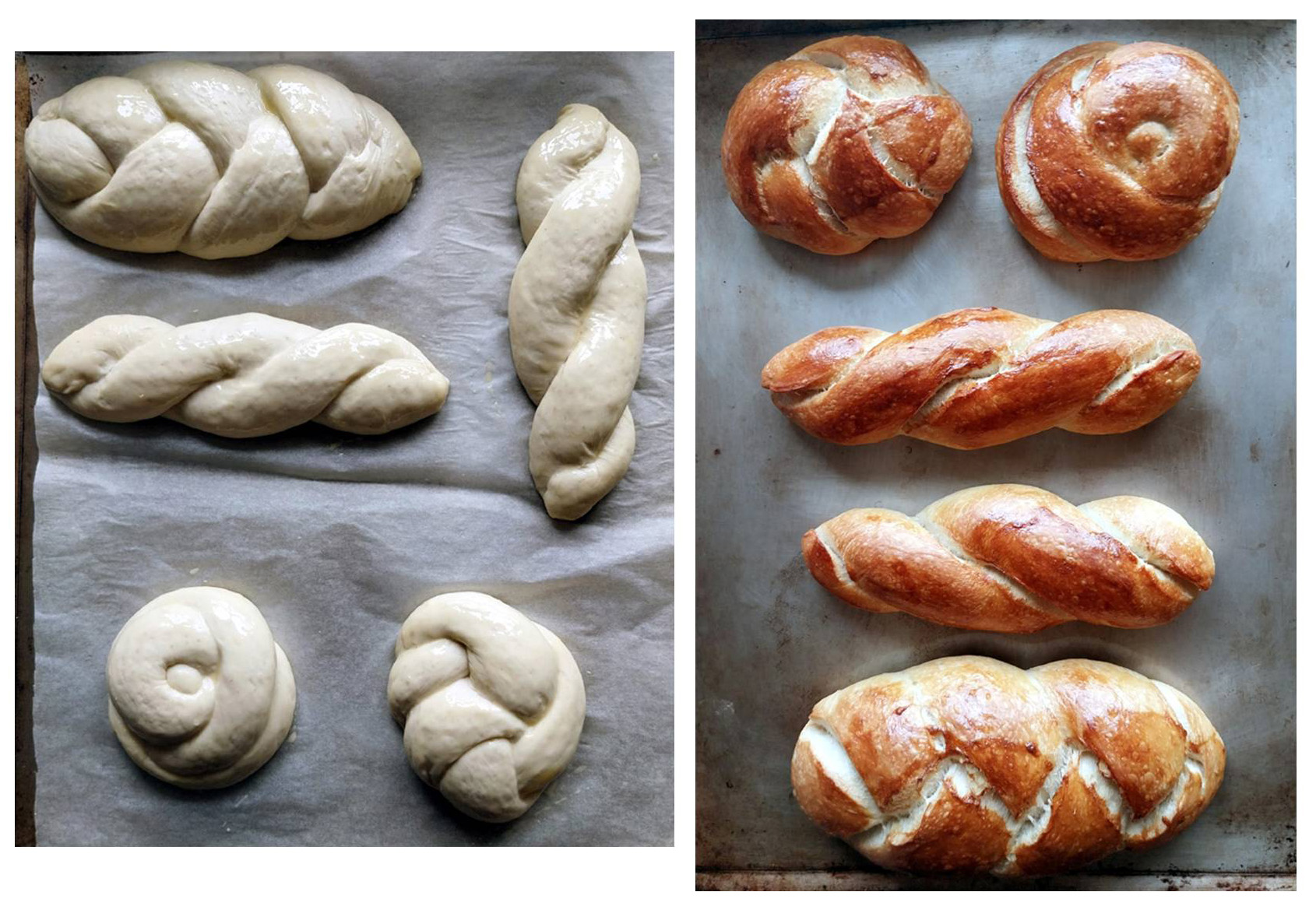
Pretty happy with this but need more shaping practice. Think the two-strand braids are a bit small.

I was happy with the three-strand loaf at 320g so left it out of the third bake. I thought the weight of the two-strand buns at 160g was right but my shaping needed improving. The two-strand braids at 160g were a little small so I increased them to 200g.
For the third bake (2 buns @ 160g, 4 braids @ 200g) I needed 1120g dough. This is where my spreadsheet calculator saves the day – just change the dough weight and press the button …
Pleased with the result. Buns much better shaped. More care taken over rolling out the strands for the braids so that they are fatter in the middle which is reflected in the shape of the finished breads. Room for improvement but a good base to start from.
Used my usual method: hand mixed, 10 kneads repeated 3 times with 5 mins rest between each. 4 hours bulk fermentation, stretch and fold at the end of first 3 hours, (although I fermented the dough overnight in the fridge for the last two bakes), shape, 3.5 hours prove. Egg wash. In the Pico 250C top, 220C bottom. 10 minutes steam, 2nd coat egg wash. 30 minutes total, heat lowered a little for the last 10 minutes (use your judgement – like if it’s starting to burn, turn the heat down!).
Plenty in this book to keep me going – gonna have to get me a 25K sack of T45 flour.


 The PArtisan Baker