
I reckon that “fast food” is extremely hard to get right. It’s widely derided as being unhealthy and the fast route to obesity. But, when you consider the basic ingredients, it doesn’t have to be like that and can produce very fine, simple, relaxed food – different to the dreaded “fine dining” …
Consider the burger. I quite often test out a new restaurant by trying their hamburger on the grounds that, if they can’t get that right (or can’t be bothered to get it right), it doesn’t give you much hope for their more complicated dishes. They don’t often impress …
Strikes me that the only two essential elements of a burger are the outer bun and the inner beef patty and if they aren’t perfect you’re wasting your time. Virtually all burgers fail on the bun with no attention being paid the the quality of the bread. (There’s a restaurant in Conwy that proudly announces on the menu bread from a local bakery. This is supposed to be a big plus but it makes me hold my nose.)
The same is probably true of the majority of patties, poor quality mince with most of the flavour coming from the grill. It sometimes seems as though the purpose of the ever growing size of commercial burgers and the number of additions is to disguise the poor quality of the basic ingredients.
Still, rather than slagging off the commercial sector, let me tell you about my small steps towards a good burger.
First off, he said modestly, we cracked the bun issue some time back with my brioche burger bun.
*Had a burger in an Anglesey bistro recently where they advertise the fact that their brioche bun is made by the award winning Alex Gooch – wasn’t bad but …
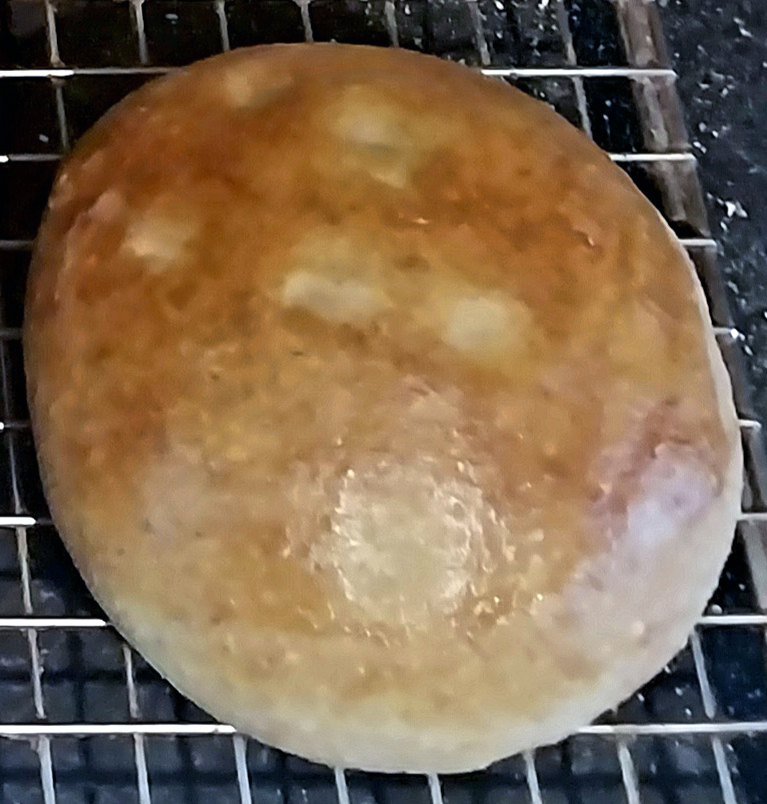
These buns are scaled at 120g which sounds big but they are light enough not to intrude and robust enough to carry a good load without disintegrating. Formula here.
The beef patty is the other main issue. Up until recently I made do with supermarket mince which is lacking in most things (except water). I decided that, if I’d reached that stage in life where decline is becoming apparent, I might as well splash out on the odd little extravagance like a mincer attachment for the Kenwood. (There’s also the pasta attachments but that’s a different story.)
And what shall we feed the mincer? We’ve been making use of the online meat and fish suppliers Field and Flower to occasionally stock up the freezer so it was the obvious place to start. Heading for the cheaper cuts we tried shin a couple of times (too tough but made a fabulous Tavas after two hours cooking) and we are currently on shoulder. £12.98 a kilo: about 750g once the outer fat removed and minced: divided into 3 packs at 250g: one patty = 125g = c. £2.17 per burger. Not bad for quality beef.
For guidance I’ve been following Neil Rankin – Low & Slow, How to Cook Meat. He gives a pithy “Don’t add anything to your mince and don’t play about with it too much” – so I don’t. His patty weight (160-200g) is bigger than mine but my 125g seemed plenty last time we had them. His method is to form a loose ball and flatten with your hand to form a rough disk about 1.8cm thick not worrying about any raggedness. Salt the top surface, place salt side down in a hot pan and press down lightly with a spatula. Sprinkle the second side with salt and cook for 3 minutes. Turn over and cook for a further 2 minutes to produce a rare burger. To continue cooking place on a heated tray in an oven preheated to120C – 5 minutes for medium rare – 11 minutes for medium.
He say “This cooking technique is all about crust development and texture variance.”. The outside is crunchy and the inside is soft. “You want it to be literally falling apart and ugly. The uglier the better.” Very interesting book …
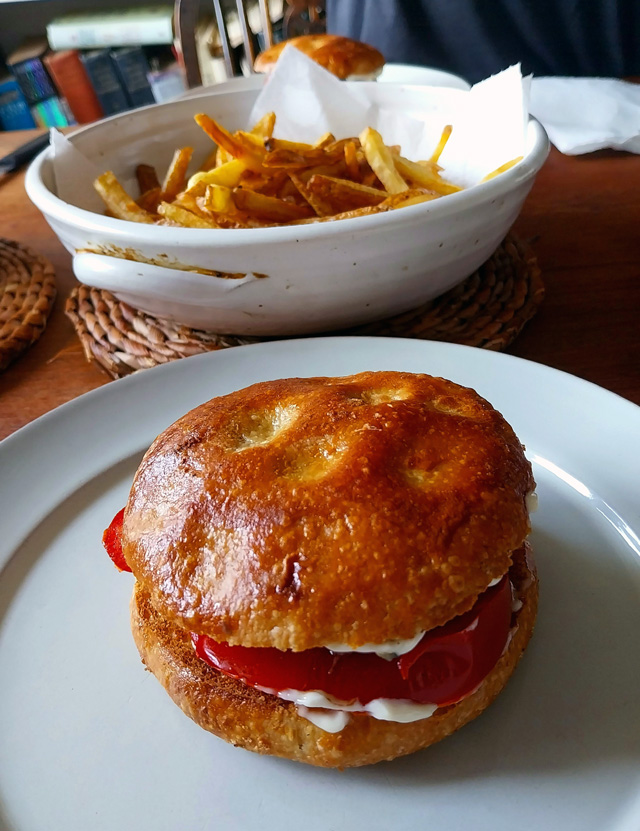
Then come the additions. These I am still working on. I think you have to have onions in some form and, of late I’ve been making an onion braise borrowed from Richard Ehrlich’s The Lazy Cook, a really useful book of cooking techniques that you can still pick up second hand. You simply slice onions very thinly and braise them slowly covered in a little olive oil with a teaspoon of sugar + salt and pepper for about 35 minutes, add a couple of tablespoons of sherry vinegar and continue cooking covered for 35 minutes more. Make a heap of them – they’re really handy for all sorts of dishes.
I haven’t got much beyond this. The buns are split and toasted and spread with butter and mayo. These burgers had a slice of tomato on the bottom, the onions and a few small walleys (gherkins) on the top. This is what I have to work on: what else to put in the bun that enhances but doesn’t overwhelm the essentials. I hate multi-storey burgers: I think you should be able to pick them up comfortably to eat without needing a change of clothes afterwards.

Of course, the other vital element is the frites – how could you have a burger without decent chips? A lot of restaurants seem to think you can.
I think I’m quite reasonable at chips. I fry them in rapeseed oil in a wok which is a fairly high risk operation, not to be recommended. But I’ve been doing it for a long time and the idea of having an air-fryer in the house is as bad as having a microwave …
I don’t do anything clever like soaking them in cold water to get rid of the starch or sticking them in the freezer between fries. I just fry them once until the bubbles indicate that the water has mostly evaporated, remove the from the pan and bring the oil back up to temperature, fry them again until they’re golden and crisp, drain them again and set aside. Then, when everything else is ready and the burgers assembled, fry them a third time until they are really crisp.

I think that the art of fast food is getting everything ready to dish at the same time.
*Checking their menu just now I notice that Alex Gooch’s name has disappeared and it is now described as a “grilled house bun”.

 The PArtisan Baker